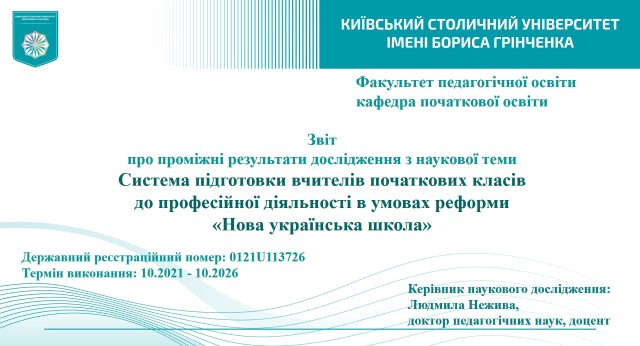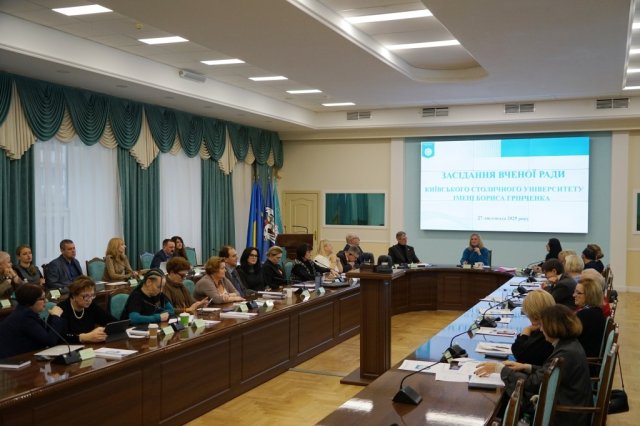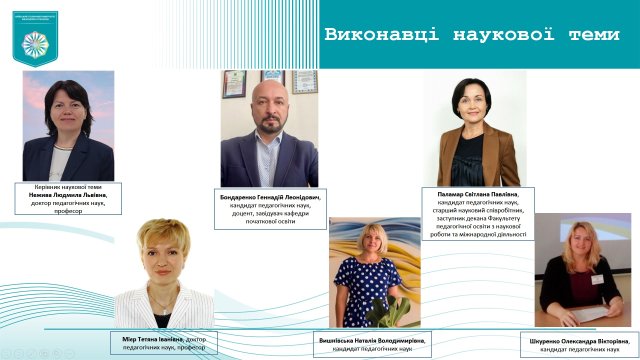

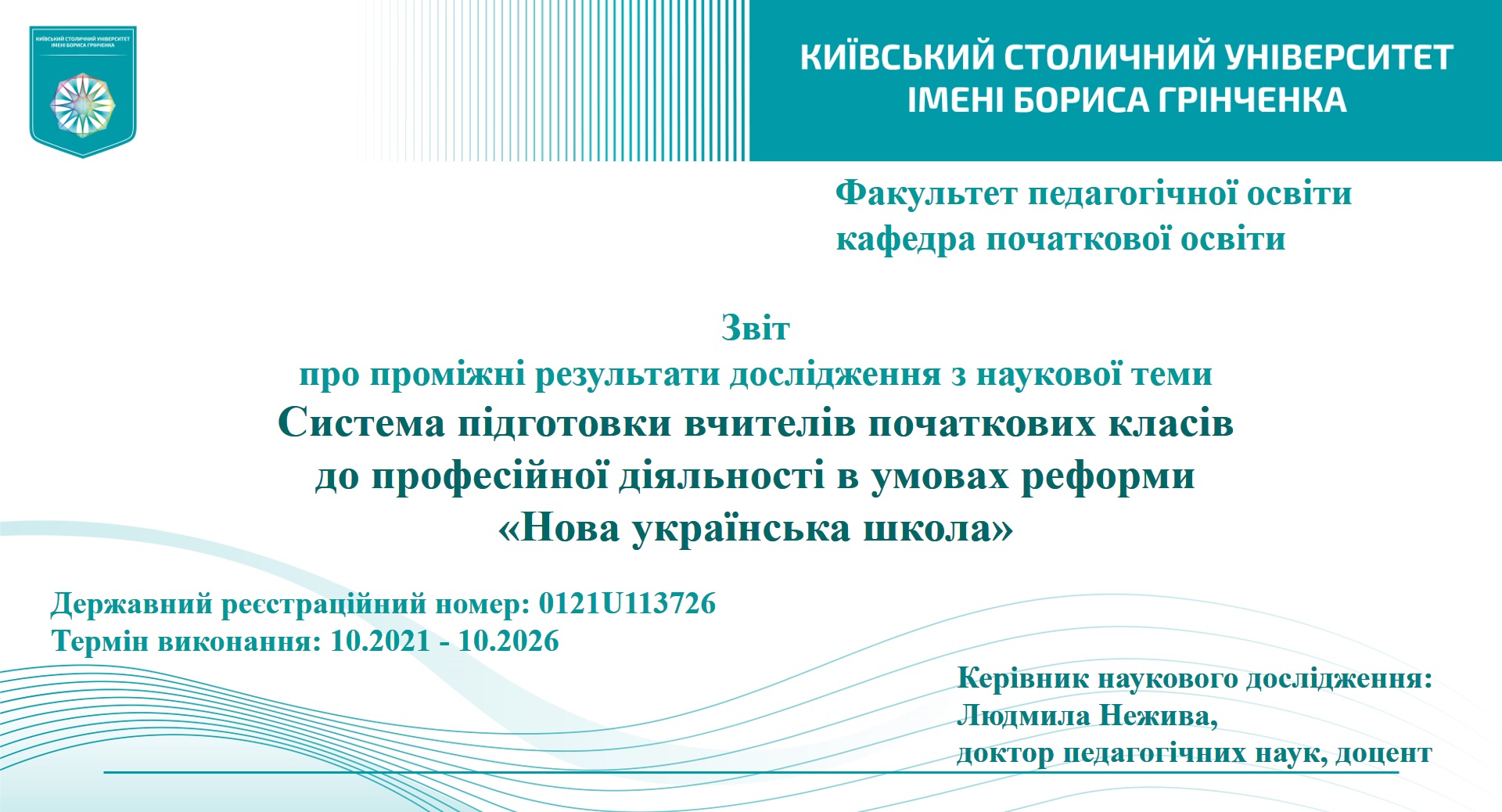
On 27 November 2025, the Academic Council of Borys Grinchenko Kyiv Metropolitan University approved an interim report on the implementation of the research topic of the Department of Primary Education, Faculty of Pedagogical Education, “The System of Training Primary School Teachers for Professional Activity in the Context of the New Ukrainian School Reform” (registration No. 0121U113726; implementation period: 2021–2026).
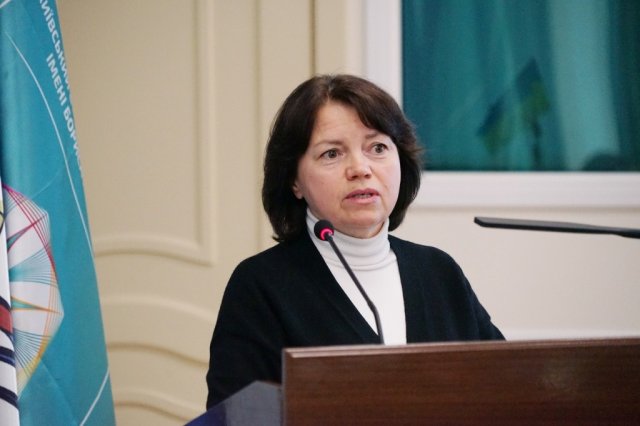
The research results for the period from October 2021 to October 2025 were presented by the project leader, Liudmyla Nezhyva, Professor of the Department of Primary Education, Doctor of Science in Pedagogy, Associate Professor.
During the implementation of the research topic:
- at the first (analytical-diagnostic) stage (2021/2022) – a research concept for the system of training future primary school teachers in the context of the New Ukrainian School (NUS) reform was developed; the main research directions were identified (“Theoretical and methodological foundations of primary school teacher training in the context of the NUS Concept”, “Competence-based model of professional training of future primary school teachers”, “Creating the NUS context in higher education institutions”, “Partnership interaction, mentoring and coaching in the training of students majoring in Primary Education”, “Readiness of future teachers for professional activity in the NUS context and under conditions of uncertainty”); the monitoring was conducted.
- at the second (theoretical-modelling) stage (2022/2023) – the alignment of the higher education institution’s educational environment with the NUS professional environment at different levels of the educational process was analysed; a structural and functional model of the system of training primary school teachers for professional activity in the context of the NUS reform and under conditions of uncertainty factors was developed; the content and methodological support for teacher training for professional activity in new social realities was improved, in particular the Educational and Professional Programme for first-cycle (bachelor’s) students majoring in Primary Education was updated; new educational components/courses were developed (“Well-being of Children and Teachers”, “Distance Learning in Primary School”, “Information and Media Literacy”, “Culture of Assessing Learning Outcomes of Primary Education Students”, “Fundamentals of STEAM Education”, etc.), and the content of course syllabi and electronic learning courses was updated.
- at the third (formative-implementation) stage (2023/2025) – the developed system was implemented through three phases (motivational–cognitive, activity–creative, and value–reflective), the main content concepts of which include: the NUS Concept; a safe educational environment for primary school pupils; trauma-informed teaching; modern primary school didactics; innovative teaching methods and technologies; the use of digital resources in the professional activity of primary school teachers; distance education; communication, partnership, inclusion, and student support; and psychological techniques for providing emotional support to oneself and to pupils. Professional training is carried out through an updated rotational model of teaching practice and a set of practice-oriented activities that ensure the integration of the cognitive, activity, and reflective components of the developed system.
The research objectives were achieved through the establishment and effective operation of professional development hubs: the NUS Mentoring Studio; the Center for Innovative Educational Technologies; the Pedagogical Supervision Studio; and the Studio of Musical and Poetic Creativity.
The research results were tested
- at the international level:
- Scientific events: a Scientific Webinar with international participation of the University of Natural Sciences and Humanities in Siedlce and the Department of Pedagogy of the Biala Podlaska Academy of Applied Sciences named after John Paul II (2022); a Ukrainian Scientific and Practical Online Conference with international participation of educators from Poland, Finland, and Cyprus (2023).
- Publications: 42 articles published in journals indexed in Scopus and Web of Science.
- The research results were presented at over 40 international scientific and practical conferences.
- International grant applications submitted:
- Democracy-Tales, Erasmus KA203, 2023
- Civic-TALES, Erasmus KA203, 2023
- VITALITY, Erasmus+ Jean Monnet, 2024
- EU triad, Erasmus+ Jean Monnet, 2024
- Effectiveness evaluation of strategies to assist Ukrainian children who were internally displaced during the second wave of migration in Ukraine, Polish National Agency for Academic Exchange (NAWA) Urgency Grants Programme, 2024
- The European and Ukrainian triad "Values-Happiness-Well-being" (EU-UA-triad), Erasmus+ Jean Monnet, 2025
- The vitality of modern youth in the conditions of social and political uncertainty in Ukraine (VITALITY), Erasmus+ Jean Monnet, 2025
- at the national (Ukrainian) level:
- Scientific events: two scientific round tables were conducted.
- Publications: seven chapters in collective monographs, 67 articles in professional
journals, and six textbooks were published.
- The research results were tested at more than 50 national scientific and practical conferences.
- at the university level:
- Monitoring: the level of readiness of future teachers for professional activity in the context of the New Ukrainian School reform and under conditions of uncertainty was assessed.
- Curriculum development: eight academic courses representing innovative directions of professional training were developed.
- New training directions activated in wartime conditions: distance and blended learning; psychological techniques for providing emotional support to oneself and pupils; designing a safe educational environment for students.
- Implementation: 15 innovative technologies for developing professionalism in future primary school teachers were integrated into the educational process.
Materials provided by SMC for Research, Scientific Projects and Programmes