
23 April 2026
Borys Grinchenko Kyiv Metropolitan University
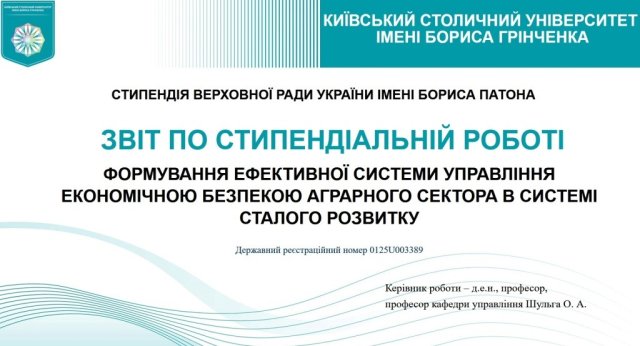
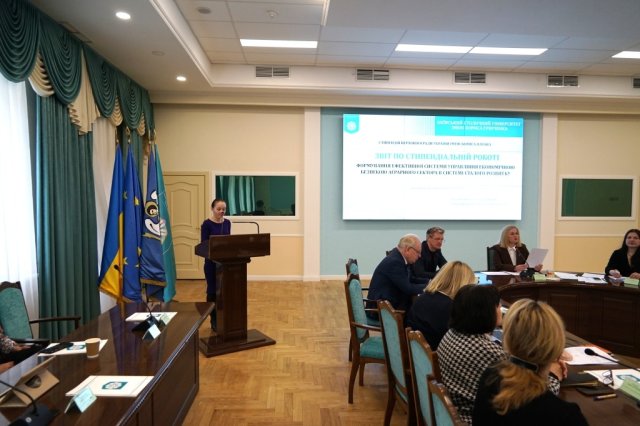
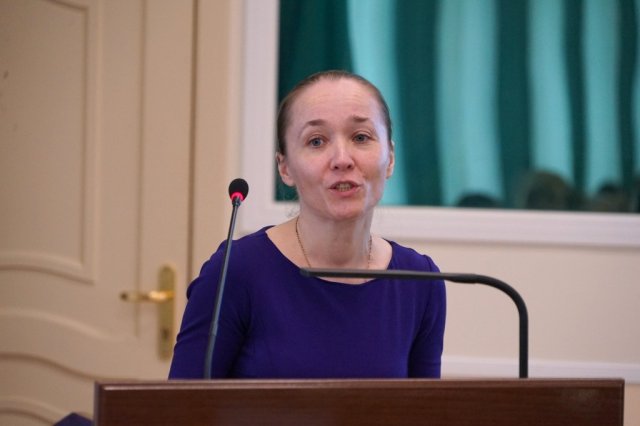
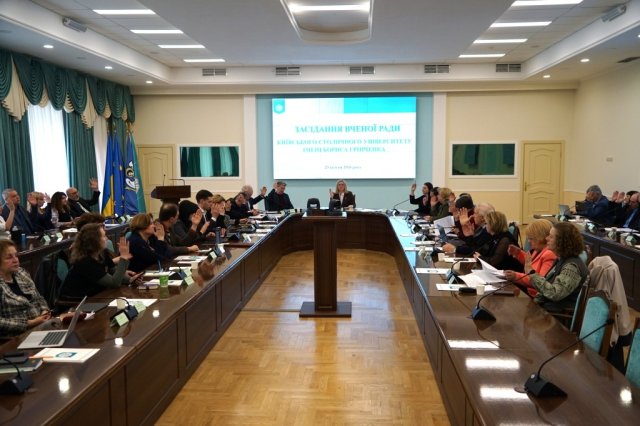
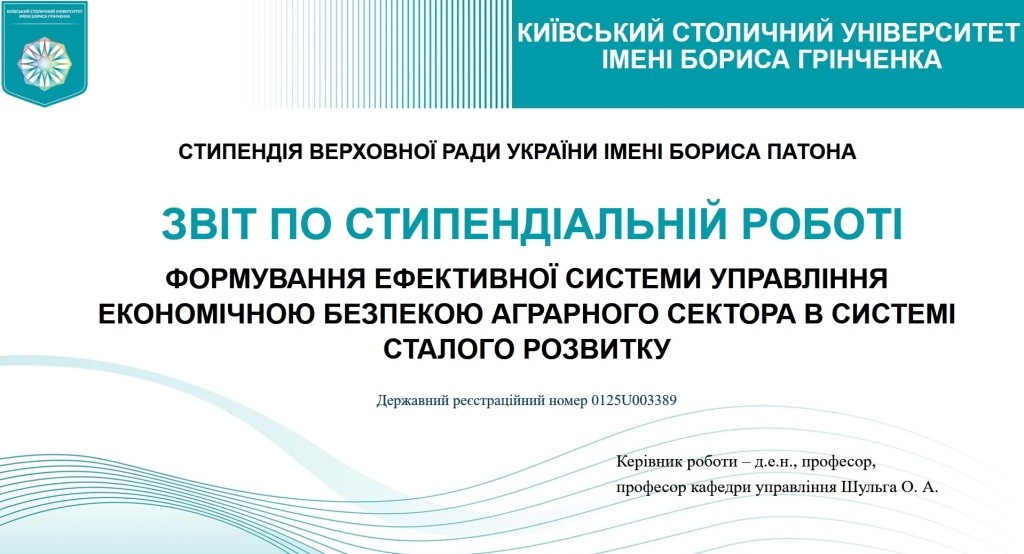
On April 23, 2026, at the meeting of the Academic Council at Borys Grinchenko Kyiv Metropolitan University, the report of Olha Shulha, recipient of the Borys Paton Verkhovna Rada of Ukraine Scholarship, Doctor of Sciences in Economics, Professor, Professor at the Department of Management, on the completion of her research project entitled “Developing an Effective Economic Security Management System for the Agricultural Sector within the Framework of Sustainable Development” (registration number: 0125U003389; implementation period: January 2025 – April 2026) was approved.
The purpose of the study is to substantiate the theoretical and methodological foundations and to develop practical recommendations for the formation of an effective, self-regulating economic security management system for the agricultural sector, capable of ensuring sustainable development and the strategic viability of business entities under conditions of dynamic threats and wartime challenges.
The fundamental and applied results of the study encompass three key areas of scientific contribution that constitute an independent theoretical and methodological foundation for the field: the development of a structural and logical model for forming an effective economic security management system for the agricultural sector as an integrated architecture of managerial decision-making; the improvement of a system of indicators for the comprehensive assessment of the effectiveness of economic security management in the agricultural sector and the implementation of measures aimed at its enhancement; and the identification of ways to improve risk management and financial stability strategies for the agricultural sector under conditions of instability.
In the research work
for the first time
– a conceptual approach to the interpretation of the economic security of the agricultural sector as a dynamic system of agricultural resilience has been substantiated. In contrast to static protection-oriented approaches, this concept defines the sector’s capacity for self-regeneration and structural transformation under conditions of extreme uncertainty. Such an approach makes it possible to consider security through the synergy of three functional vectors: adaptive (flexible response to wartime shocks), restorative (regeneration of resource potential), and strategic (compliance with the imperatives of the European Green Deal);
– an integrated model for the digital demining of agricultural landscapes has been developed, the methodological basis of which combines UAV magnetometry and neural network analysis for the creation of predictive maps of territorial contamination. The application of this model transforms humanitarian demining from a lengthy mechanical process into a high-tech big data management operation, which constitutes a critical prerequisite for restoring the territorial integrity of agroecosystems in the post-war period;
– an institutional architecture of the agricultural micro-cluster as a basic structural unit for rural area recovery has been formulated, operating on the principles of energy autonomy and a closed-cycle production system. This made it possible to substantiate a model of decentralized agricultural production that minimizes dependence on damaged critical infrastructure and promotes the capitalization of local natural resources;
– strategic foundations for the environmental diplomacy of the agricultural sector have been identified, where the implementation of decarbonized technologies and the development of the national brand Ukraine Eco-Friendly are regarded as key instruments for overcoming cross-border carbon barriers. It has been substantiated that the transition to climate-neutral production is not only an environmental obligation, but also a strategic factor in ensuring the competitiveness of domestic agribusiness in the EU market;
there have been improved:
– methodological support for assessing the economic security of agricultural enterprises, which combines consideration of exogenous wartime threats with probabilistic forecasting of the qualitative characteristics of land resources. Through the use of intelligent monitoring systems, proactive diagnostics of the sector’s condition are ensured, enabling preventive decision-making and preventing the system from entering a zone of critical instability;
– the organizational and economic mechanism for managing the security of the agricultural sector, based on the implementation of an intelligent digital platform within the framework of the State Agrarian Register using blockchain technologies. The improved mechanism ensures end-to-end transparency of value-added chains and the automation of recovery resource allocation, in line with the international accountability standards of the “Build back better than it was” principle;
further developed:
– the theoretical and methodological substantiation of Ukraine’s role in the global collective security system, enriched by the provision that the stability of Ukrainian agricultural exports serves as a strategic safeguard against international migration crises and geopolitical destabilization in the countries of the Global South. This makes it possible to identify the agricultural sector not merely as a raw material exporter, but as a critical architect of global food stability;
– the substantive characterization of the interrelationship between socio-economic relations and technological modes of production through demonstrating the priority of the transition to regenerative agriculture under the conditions of the Fourth Industrial Revolution. New contradictions of technological development have been identified: between the need for rapid digitalization and the financial exhaustion of producers; and between the benefits of intensification and the threats of biodiversity loss caused by wartime impacts;
– the toolkit for ensuring the financial resilience of agribusiness through substantiating the use of ESG-linked financing, green bonds, and the digitalization of capital through DeFi platforms. The application of these instruments, combined with international war-risk insurance, makes it possible to unlock foreign investment inflows into high-risk areas and ensure the technological modernization of the sector on the basis of energy independence.
The practical significance of the obtained results lies in the fact that the formulated theoretical provisions, methodological approaches, and practical recommendations constitute an applied basis for transforming the management systems of enterprises in the agricultural and related sectors under conditions of high uncertainty. The proposed toolkit enables business entities to transition to proactive models of economic security management by integrating digital solutions and sustainable development principles into operational activities.
The practical significance of the scientific results has been confirmed by relevant implementation documents: UPSK PrJSC (a system of financial, technological, and risk indicators for the accurate differentiation of insurance tariffs, as well as the author’s approach to detecting hazardous conditions for improving algorithms for settling insurance claims in the agricultural sector, has been adopted for implementation); ALFA-VET LLC (security indicators for identifying threats of price instability and mobile GPS-based logistics control tools have been implemented, resulting in a 15–20% reduction in security-related costs); REKAVA LLC (a risk identification subsystem has been applied for the early detection of liquidity threats and raw material shortages under wartime conditions, and intelligent monitoring tools have been introduced); ESTE SOLUTION LLC (a two-level threat identification model has been applied to forecast the stability of organic raw material supplies, together with a methodology for assessing social impact and approaches to analyzing weak danger signals for the development of loyalty programs and the prevention of financial losses caused by market volatility).
Based on the results of the research, 13 scientific publications have been published, including: 1 single-author monograph, 2 articles in scientific periodicals indexed in the Web of Science scientometric database, 8 articles in Ukrainian specialized scientific journals included in international scientometric databases, and 2 publications in the proceedings of international scientific and practical conferences.
The expediency of continuing research in this area is обусловed by the need for the further development of tools for the cyber-physical protection of critical agricultural infrastructure and the creation of mechanisms for adaptation to carbon regulation within the framework of European integration processes. A promising direction is the development of artificial intelligence algorithms for managing autonomous production units under conditions of post-war territorial recovery, which will enable Ukraine to consolidate its status as a global hub of agroecological innovation.